HealthX
- Gemini
- OpenStreetMap
- Overpass API
1st runner-up, FutureBuilders 2025.
The problem
In Bangladesh's hill tracts and remote rural areas, medical help can be hours away over unpaved roads, rivers and steep forest, and the internet is slow or absent exactly when someone needs advice. An app that assumes a good connection fails the people it is meant for.
HealthX was built with Saibul Haque Jessan (May his soul rest in peace) for FutureBuilders 2025 at North South University, where it took 1st runner-up. The brief was a health-support tool for people with limited internet access, so the design starts from what happens when the connection drops, instead of treating offline as an afterthought.
What it does
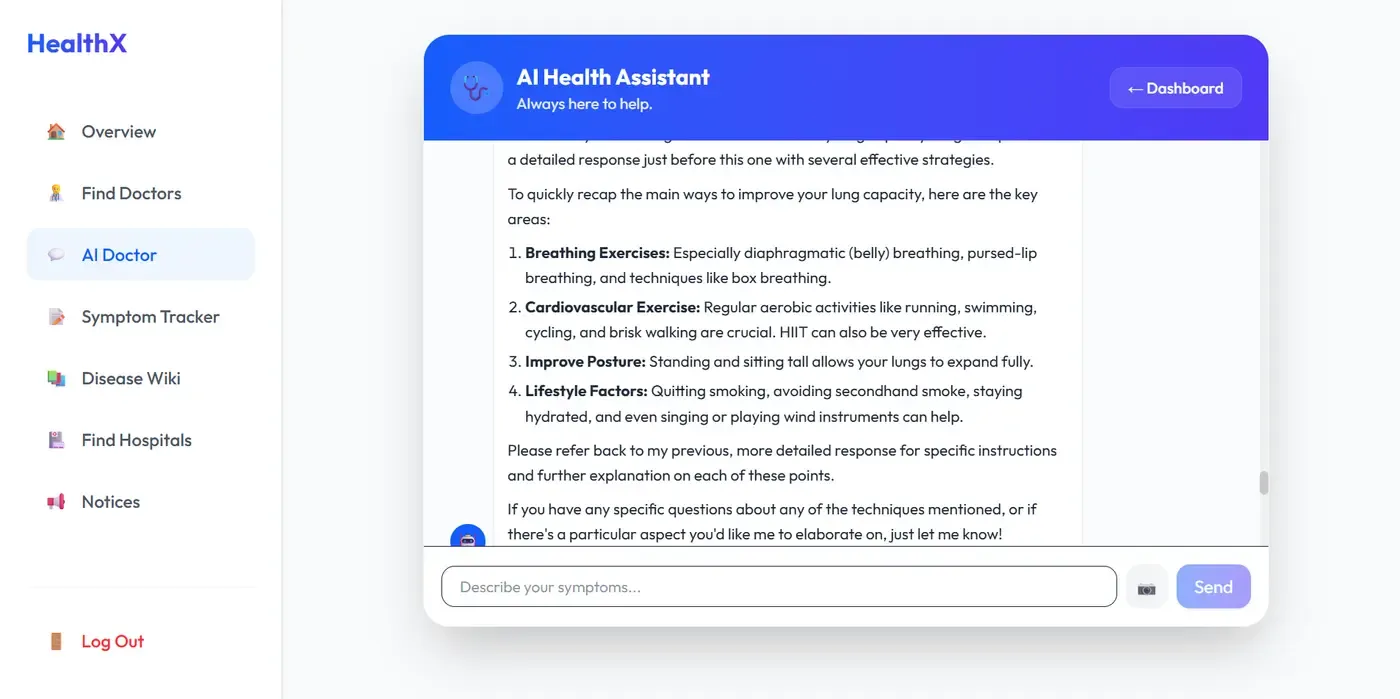
- AI Doctor. A chat assistant powered by Gemini 2.5 Flash that accepts text and a photo, such as a rash or a wound. Every conversation is stored per user, and each reply is generated with the last 10 messages as context, so a follow-up question does not start from zero.
- Symptom tracker. A guided interview rather than a chatbot. The model is instructed to ask one short question at a time, hold back from diagnosing too early, and only then give probable conditions, a severity of low, moderate or high, and home-care or see-a-doctor advice, always with a disclaimer and never claiming to be a doctor.
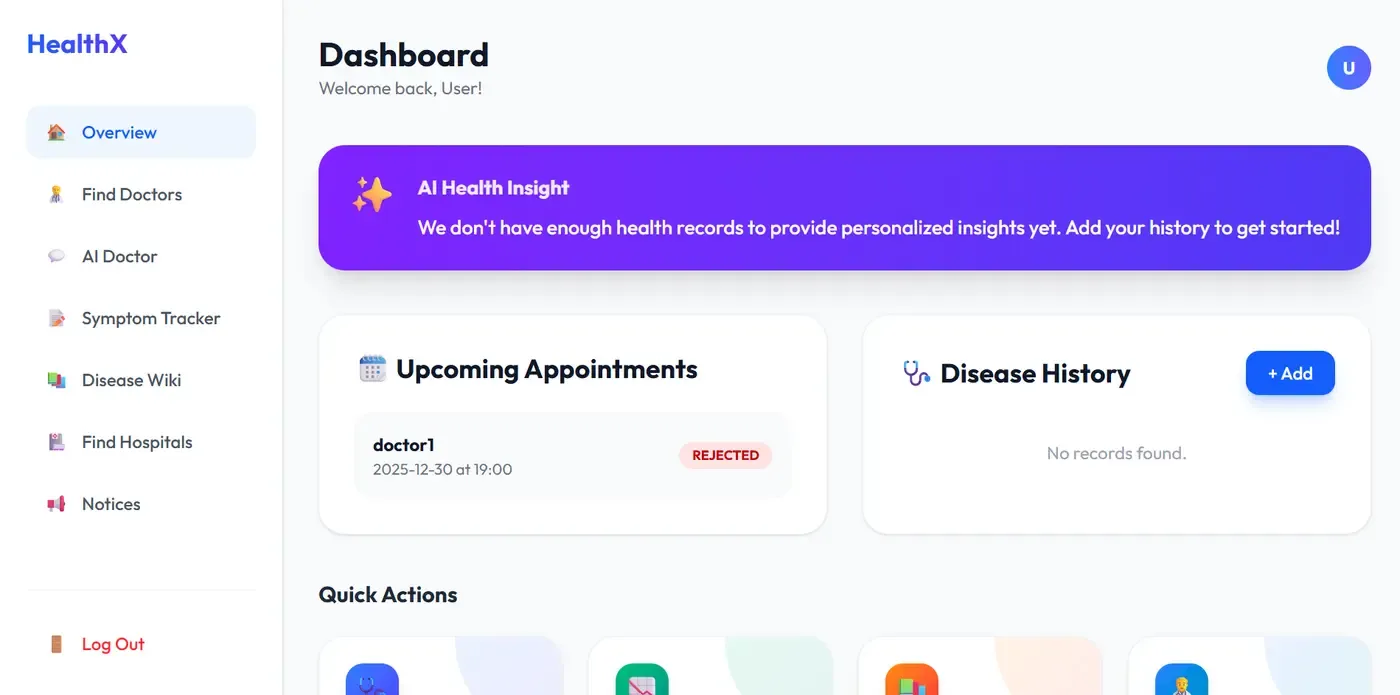
- Health history and insight. Patients keep a disease history. The dashboard turns the most recent records into a short, encouraging prevention tip, and says plainly when there is not enough history to say anything.
- Digital OPD. A patient browses doctors and requests an appointment with a date, time and reason. The doctor has their own dashboard with counts and a request list, and moves each request through accepted, rejected and completed. Because it is a request flow rather than a live call, it still works on an unstable connection.
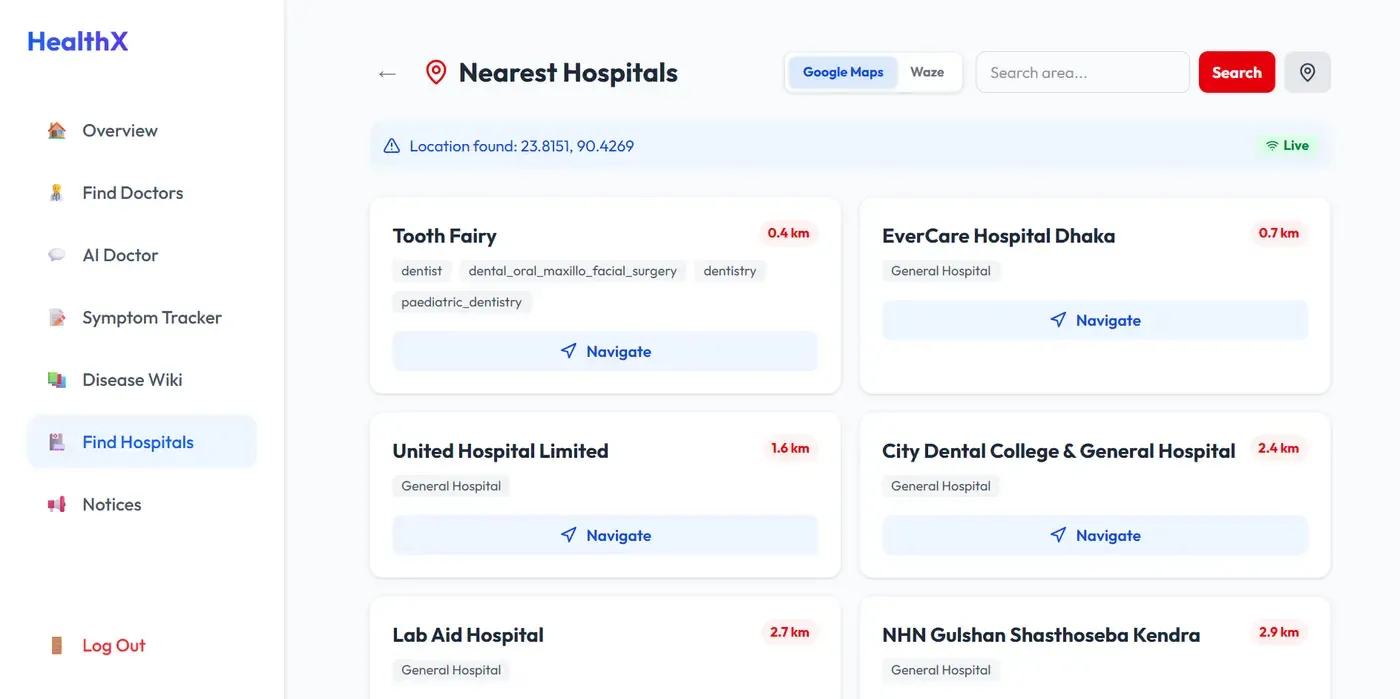
- Hospital finder. Uses the phone's GPS to list nearby hospitals with distance, and opens turn-by-turn directions in Google Maps or Waze.
- Disease encyclopedia. Plain-language summaries of common conditions, in Bangla by default with an English switch, pulled from Wikipedia.
- Notice board. A bilingual page for community health alerts such as vaccination drives and cold waves.
Patients and doctors register with different roles and land on different dashboards, with routes guarded by role.
Designing for a weak connection
The most important decision was that the app degrades instead of breaking.
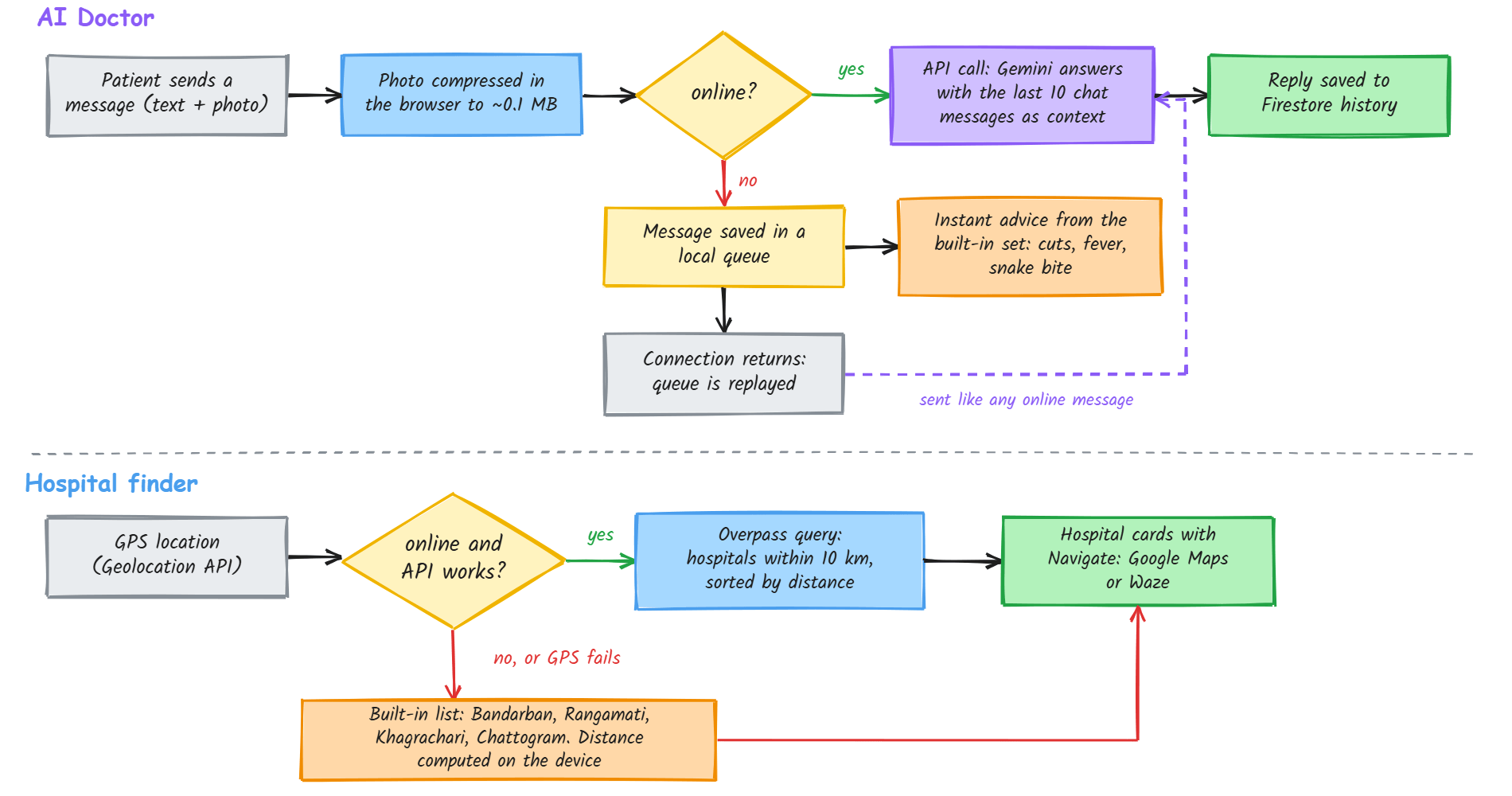
- Messages are never lost. If the device is offline when a message is sent, it is saved to a local queue and the person immediately gets basic first-aid guidance from a small built-in set covering cuts and bleeding, fever, and snake bites, where the advice includes not to suck the venom and to go to a hospital. When the browser reports that the connection is back, the queue is replayed to the API and the full AI answer arrives.
- Photos are shrunk before upload. Images are compressed in the browser to about 0.1 MB, so a photo still goes through on a 2G or 3G link.
- The hospital finder has a fallback. Online, it asks OpenStreetMap's Overpass API for hospitals within 10 km and sorts them by distance, calculated with the haversine formula. If the request or the GPS fails, it switches to a built-in list covering Bandarban, Rangamati, Khagrachari and Chattogram Medical College, and computes distances on the device. A badge shows whether the data is live or offline.
Under the hood
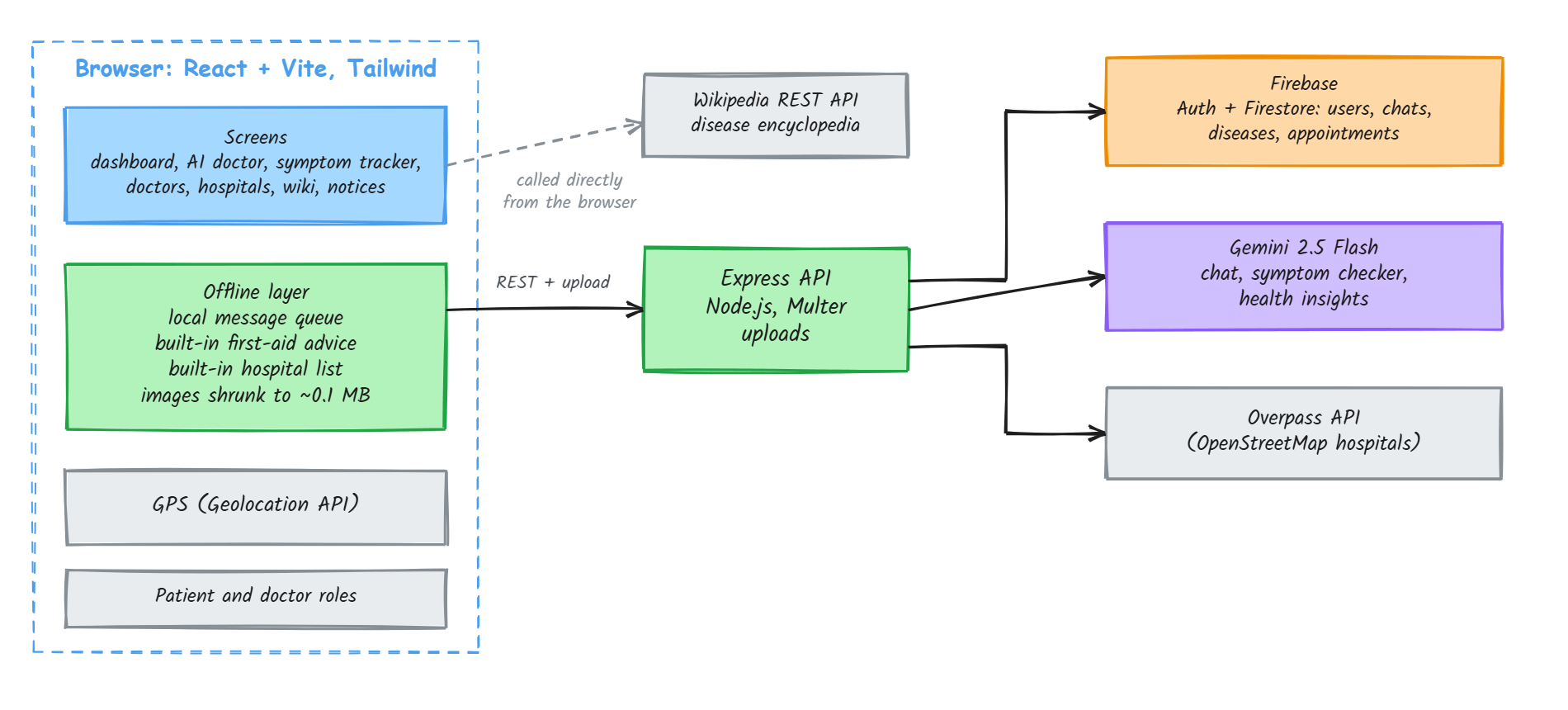
The frontend is React with Vite, TypeScript and Tailwind. The backend is a small Express API using Multer for image uploads and Axios to proxy the Overpass query, with Firebase handling authentication and Firestore storing users, chats, diseases and appointments. The Gemini calls and the API key stay on the server. The encyclopedia calls Wikipedia directly from the browser.
Limits
HealthX is a competition prototype, and some parts are honest sketches. The offline advice is a deliberately tiny keyword set, not a medical knowledge base. The encyclopedia needs a connection, the notice board shows static sample notices, and the AI is a first-aid guide that sends people to real doctors, not a replacement for one.